When you stand on Schweitzer and look down at Lake Pend Oreille shining below, you are looking across a homeland far older than the resort, the town of Sandpoint, or Idaho itself. For thousands of years this lake, its rivers, and its mountain shores belonged to the Kalispel people, an Interior Salish people whose own name, Ql'ispé, means lake or river paddlers, as the Bonner County Historical Society explains. Fur traders called them Pend d'Oreille, French for hanging from the ear, after their circular shell earrings.
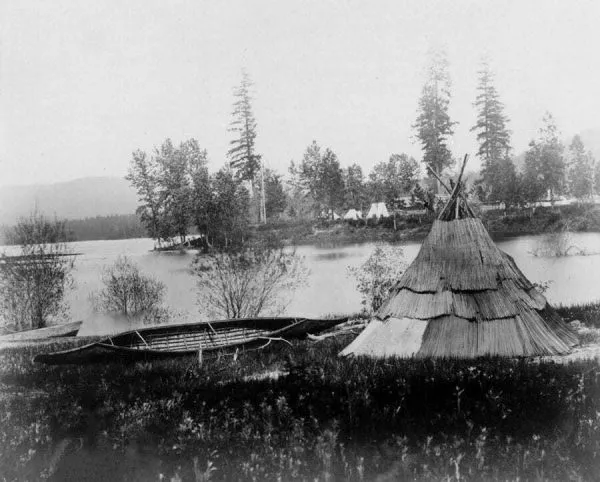
The Kalispel world was bound together by water. The tribe itself says it was ntxwe, the Pend Oreille River, that linked one end of Kalispel country to the other, some 200 miles in length, from Lake Pend Oreille toward what is now Paradise, Montana, and northwest across northeastern Washington to the mouth of the Salmo River in British Columbia. They traveled that country in distinctive sturgeon-nose canoes, moving with the seasons between fishing camps, hunting grounds, and gathering places, including a village where Sandpoint stands today.
That seasonal round was rich. Kalispel families fished for bull trout and mountain whitefish, hunted deer, elk, caribou, and bear, and gathered bitterroot, serviceberries, chokecherries, and huckleberries. Above all came camas. Women dug the bulbs with elk-antler and ironwood digging sticks, carried them in cedar-bark sacks, and steam-roasted them in pit ovens, sometimes with black tree lichen softened with bear grease or deer marrow. Along the marshy shores they cut tule and cattail stalks and wove them into mats that covered their encampment lodges.
Change came hard in the 1800s. Disease cut the population deeply, and by 1875 only 395 Lower Kalispel remained, according to the tribe. As settlers moved in from 1880 to 1910, many filed Homestead Act claims on land that was rightfully Kalispel home. The Upper Kalispel were removed to the Flathead Reservation in Montana, while the Lower Kalispel refused to leave their homeland along the Pend Oreille River. Long after, they still returned each year to gather at Indian Meadows at the mouth of the Clark Fork River and to hold a powwow east of what is now Sandpoint City Beach, a tradition that continued into the early 1950s.
Recognition, when it came, was small. On March 23, 1914, the President of the United States established the Kalispel Reservation: about seven square miles on the east bank of the Pend Oreille River near Usk and Cusick, Washington. From that base, and through decades when, in 1965, the tribe had only one telephone and an average member income of about 1,400 dollars a year, the Kalispel endured. Today the tribe counts 470 members, holds additional trust land in northern Idaho and northeastern Washington largely to preserve forests and natural resources, and still keeps its yearly powwow and a buffalo herd at Usk. Next time the lake catches the evening light below Schweitzer, remember the paddlers who were here first.