
Long before Sandpoint had a name, Lake Pend Oreille had people. The Kalispel — called Pend d'Oreille by French fur traders, roughly "hangs from ear," for the large shell earrings they wore — made the lake and its rivers their home for centuries.
The Kalispel are an Interior Salish people, believed to have migrated south from British Columbia. They lived in tipis in summer and lodges in winter, both built from woven cattail "tule mats." They made clothing from rabbit pelts and deer hides, embellished with dyes, beads, and porcupine quills, and fashioned tools from flint.
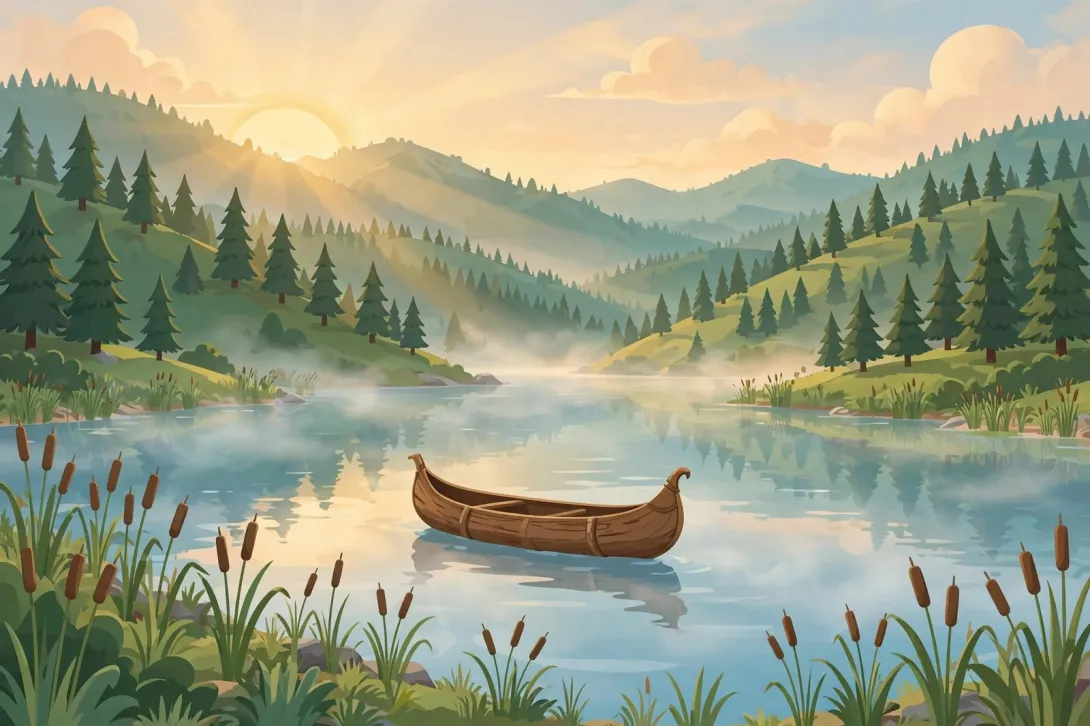
On the lake they paddled a canoe unlike any other: a bark vessel with a pointed nose and tail, the prow riding just under the water like a sturgeon's bottle snout. The design was so unusual that explorer David Thompson's men remarked on it in 1809 — and an 1860 painting of a sturgeon-nosed canoe on Lake Pend Oreille by James Madison Alden still survives in the National Archives.
The fur trade arrived that same year, 1809, when Thompson's North West Company built Kullyspell House on the lake's northeast shore, on the Hope Peninsula near the mouth of the Clark Fork. Thompson's clerk Finan McDonald raised the log storehouse and dwelling that September; the post was abandoned by 1811, off the main travel lines — but it marked the start of two centuries of outside attention on the lake. The city of Kalispell, Montana still carries the tribe's name.
Jesuits established a mission among the Pend d'Oreille in 1846. In 1855 the tribe split: the Upper Pend d'Oreille moved to the Flathead Reservation in Montana, while the Lower Kalispel stayed on their homelands in Washington — after refusing to sign a U.S. treaty in 1872. Dispossessed of their hereditary lands around the lake, the people still returned each year for a three-day pow wow on the grounds just east of what is now Sandpoint City Beach, with ceremonies, dancing, and traditional stick games, until the gatherings ended in the early 1950s.
Today the Kalispel Indian Community of the Kalispel Reservation carries the heritage forward — a heritage written into the very names of the region: the lake, the river, and the tribe itself.