Skip to header Skip to main navigation Skip to main content Skip to footer
Home
Schweitzer Mountain Resort LLC
Where Lake Views Meet Mountain Dreams

Main navigation

  • Home
  • Ski Trip Planning
  • Schweitzer Village Weather Forecast
  • About Schweitzer Mountain

Idaho History

Breadcrumb

  • Home
  • Idaho History

Priest Lake: Three Names, One Crown Jewel

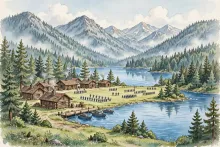
Cartoon illustration of Priest Lake, Idaho's Crown Jewel, with a historic Priest River log drive

Priest Lake has worn three names, and each one tells a story. In 1846, Jesuit priest Pierre-Jean De Smet mapped the lake and named it Roothaan Lake, for his superior in Rome. In 1865, Captain John Mullan — building the road that would bear his name from Walla Walla to Fort Benton — renamed it Kaniksu, from the Kalispel word for "Black Robe," the name Native people gave the Jesuit missionaries. The name that stuck honors the Jesuit priests who kept a base camp at Kalispell Bay in the 1840s.


  • Read more about Priest Lake: Three Names, One Crown Jewel

Kullyspell House: The 1809 Fur Post That Put the Panhandle on the Map

Cartoon illustration of Kullyspell House, David Thompson's 1809 fur trading post on Lake Pend Oreille

In September 1809 — more than two centuries before the first chairlift — the first European trading post in Idaho rose on the Hope Peninsula. Finan McDonald, working for explorer and fur trader David Thompson of the North West Company, built Kullyspell House on the northeast shore of Lake Pend Oreille, near the mouth of the Clark Fork.

  • Read more about Kullyspell House: The 1809 Fur Post That Put the Panhandle on the Map

The Navy Still Tests Submarines in Landlocked Idaho

Cartoon illustration of a Navy submarine test model on Lake Pend Oreille near Bayview, Idaho

There is a Navy submarine base in Idaho. Not a recruiting office — an actual submarine test range. At Bayview, on the shore of Lake Pend Oreille, the Naval Surface Warfare Center's Acoustic Research Detachment has been quietly testing submarine and ship designs for decades.

  • Read more about The Navy Still Tests Submarines in Landlocked Idaho

Farragut's Ghost Navy: When Idaho Briefly Became a Navy Town

Cartoon illustration of the Farragut Naval Training Station on Lake Pend Oreille during World War II

Imagine Idaho's largest city in 1942. Not Boise — a brand-new Navy base rising out of the pine forest at the south end of Lake Pend Oreille. After Pearl Harbor, the Navy needed a safe inland site to train the flood of new recruits, and it chose the wooded shoreline between Bayview and Athol. Ground was broken in March 1942, and crews built a small city almost overnight.

  • Read more about Farragut's Ghost Navy: When Idaho Briefly Became a Navy Town

Steel Across the Lake: The Railroad Bridge That Made Sandpoint

Cartoon illustration of a vintage steam locomotive crossing a wooden trestle bridge over a mountain lake.

Sandpoint exists because trains needed to cross Lake Pend Oreille. In 1882 and 1883, the Northern Pacific Railroad built a timber trestle across the lake's shallows and mudflats to meet a congressional deadline for the railroad's land grant — and a town grew around the crossing.

  • Read more about Steel Across the Lake: The Railroad Bridge That Made Sandpoint

The First People of the Lake: The Kalispel Before Sandpoint

Cartoon illustration of a traditional bark canoe gliding on a misty mountain lake at sunrise.

Long before Sandpoint had a name, Lake Pend Oreille had people. The Kalispel — called Pend d'Oreille by French fur traders, roughly "hangs from ear," for the large shell earrings they wore — made the lake and its rivers their home for centuries.

The Kalispel are an Interior Salish people, believed to have migrated south from British Columbia. They lived in tipis in summer and lodges in winter, both built from woven cattail "tule mats." They made clothing from rabbit pelts and deer hides, embellished with dyes, beads, and porcupine quills, and fashioned tools from flint.

  • Read more about The First People of the Lake: The Kalispel Before Sandpoint

The Dynamite Express: The Coeur d'Alene Labor Wars That Shook the Silver Valley

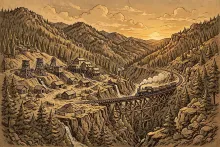
Retro cartoon illustration of an 1890s canyon mining town with headframes, an ore mill, and a steam train.

Few chapters in Idaho history are as dramatic as the mining wars of the Coeur d'Alene district — two explosions of violence, in 1892 and 1899, that pitted union miners against mine owners, drew in the governor's militia and federal troops, and ended with one of the most notorious labor bombings in American history.

  • Read more about The Dynamite Express: The Coeur d'Alene Labor Wars That Shook the Silver Valley
Subscribe to Idaho History

Copyright © 2026 - Schweitzer Mountain Resort LLC - All rights reserved

Developed and Designed by Rocky Mountain Madman LLC