
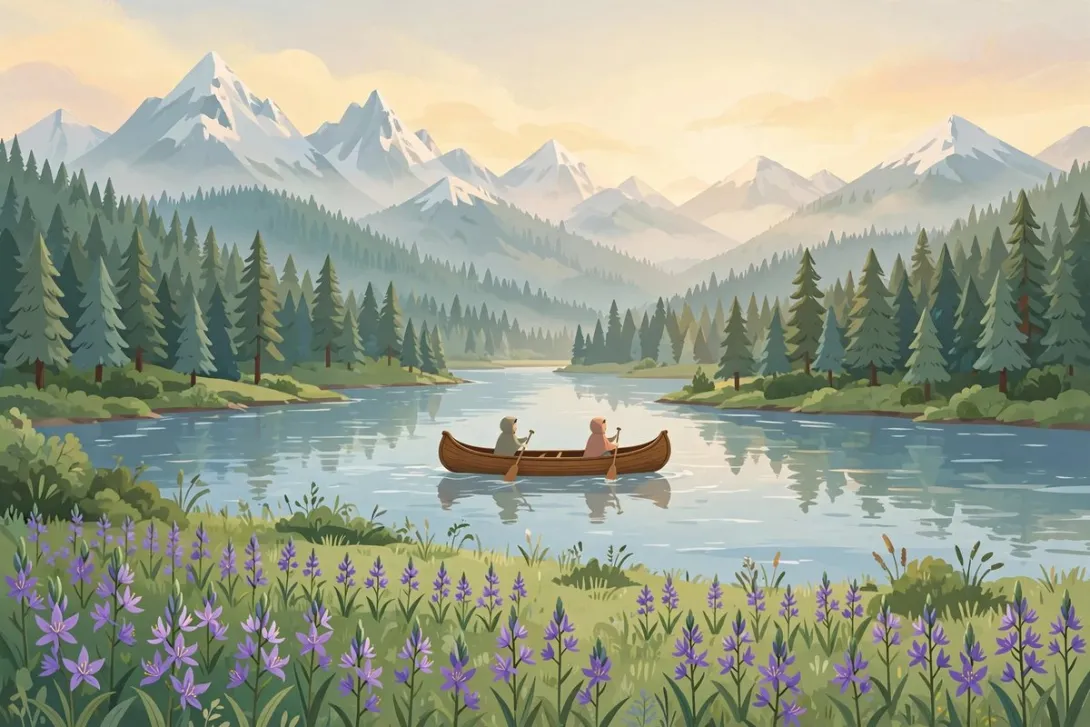
Before skis ever touched Schweitzer's slopes, the vast homeland of the Schitsu'umsh — the Coeur d'Alene Tribe — stretched across more than three and a half million acres of the Inland Northwest. It was a country of grass-covered hills, camas prairie, forested mountains, lakes, marshes, and rivers: from the southern end of Lake Pend Oreille in the north, along the Bitterroot Range to the east, down to the Palouse and the North Fork of the Clearwater River in the south, and westward to Steptoe Butte and just east of Spokane Falls. At the very center of it all lay Lake Coeur d'Alene — the heart and soul of the people.
The name the world knows them by comes from French. In the early 1800s, French traders and trappers met a people they found impossible to get the better of, and "Coeur d'Alene" — heart of an awl — was their grudging tribute to the tribe's sharp trading skills. The name first appears in writing with the Lewis and Clark Expedition in 1805 and stuck so firmly it ended up on a lake, a river, and a mountain range. The tribe's own name for themselves, Schitsu'umsh, means "the discovered people."
Water defined their days. From the St. Joe and Spokane rivers they took trout, salmon, and whitefish with gaff hooks, spears, nets, and traps, while the camas prairies yielded the roots that fed the winter villages. They hunted and gathered across the full range of their homeland, traveling with the seasons — and when horses arrived from the west, their hunting and trading reached all the way to the Great Plains. Long before Sandpoint had a railroad or Schweitzer had a chairlift, these were the people who knew every mile of the panhandle.
The hard century came fast. After the Skitswish War of 1858 and the discovery of silver in 1863, miners and settlers poured into the panhandle, and in 1873 President Grant set aside a reservation for the tribe by executive order — about 600,000 acres, later reduced by further agreements to roughly 345,000. The lake remains at the center of tribal life and identity to this day. When you stand on the mountain looking out over the water, you are looking across a homeland the Schitsu'umsh have loved for thousands of years.