
The Pend Oreille Paddler: North Idaho's Friendly Lake Legend

Did you know that the big lake you can see from Schweitzer on a clear day has its own lake monster? Lake Pend Oreille, spread out below the Selkirks, is home to the Pend Oreille Paddler, a mysterious creature said to surface as a long, dark shape moving with an undulating motion and a wide wake. Locals do not tell the story with fear, exactly. Over the decades it has become a piece of living heritage, retold on docks and beaches and passed along to every new visitor who asks what might be hiding in that deep, dark water.
Clear and Cold on the Mountain: First Flakes Behind Us, Opening Day 43 Days Out

Did you know Schweitzer has already seen its first snow of the season? The resort's own daily message reports the first official snow sighting on Saturday, October 10, with snow falling on and off through that weekend, and an Ikon Pass roundup released October 14 noted first flakes on Schweitzer with more snow on the way this week. Winter is officially on the radar, and the countdown is on: opening day is set for Friday, November 27, just 43 days from today.
The Town That Floated Upriver: North Idaho's Timber Boom and the Dover Barges
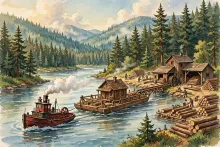
Long before ski lifts climbed the Selkirks, timber built the towns below Schweitzer. The forests around Lake Pend Oreille held prized western white pine and cedar, and once the railroads arrived, that green wealth drew loggers, mill hands, and whole new communities to Bonner County. Sandpoint grew from about 300 people in 1900 to roughly 3,000 by 1906 and about 5,000 by 1908, and boosters of the day claimed it shipped more cedar poles than any other city in the United States.
Steamboats First, Then the Iron Horse: How the Railroad Made Sandpoint

Long before a highway hugged its shore, Lake Pend Oreille was the road into this country. In 1866 the Oregon Steam Navigation Company launched the steamer Mary Moody on the lake, and she became its first official mail carrier, helping travelers push north toward newly discovered gold fields. For years afterward, steamboats were how people, mail and supplies moved here, linking little landings around the lake and up the Clark Fork River, while the forested shoreline around present-day Sandpoint was still quiet and sparsely settled.
Pray for Snow: Your Week Ahead Around Schweitzer, October 12 to 18

Welcome to mid-October in the panhandle. The lifts at Schweitzer are quiet — summer operations have wrapped, and the mountain is resting up for a projected opening on November 27 — but town life in Sandpoint, Post Falls, Coeur d'Alene, and Bonners Ferry is anything but quiet. Here is the week ahead, ski-flavored highlights first.
Golden October: Chasing Larch Season in the Selkirks

The conifer that breaks the rules. The western larch — tamarack to old-timers — is an evergreen that goes deciduous every fall, dropping its needles after turning them a brilliant gold. It's the largest of the larches, and in late September and October it sets the Selkirk high country ablaze with color.
Why does it drop its needles? Before shedding, the tree pulls nutrients back into storage — an adaptation that reduces snow damage to branches and protects against insects and fire. Come spring it flushes chartreuse-green new growth, the sign of late spring in the high country.
Kaniksu Land Trust Celebrates Sled Hill Grand Opening on October 24

Some places a town just adopts. For generations, the sledding hill off Pine Street has been where Sandpoint learns to love winter — and on Saturday, October 24, the community gets to celebrate it properly. The Kaniksu Land Trust hosts the Sled Hill Grand Opening from 11 a.m. to 4 p.m., free and open to all.
Expect live music, food, games, a pumpkin patch, and demonstrations from the Kaniksu Folk School — a thank-you to the community that showed up to protect the place. With the first phase of the master plan complete, it's finally time to celebrate together.
Priest Lake: Three Names, One Crown Jewel

Priest Lake has worn three names, and each one tells a story. In 1846, Jesuit priest Pierre-Jean De Smet mapped the lake and named it Roothaan Lake, for his superior in Rome. In 1865, Captain John Mullan — building the road that would bear his name from Walla Walla to Fort Benton — renamed it Kaniksu, from the Kalispel word for "Black Robe," the name Native people gave the Jesuit missionaries. The name that stuck honors the Jesuit priests who kept a base camp at Kalispell Bay in the 1840s.
Farragut's Ghost Navy: When Idaho Briefly Became a Navy Town
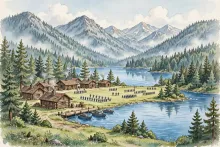
Imagine Idaho's largest city in 1942. Not Boise — a brand-new Navy base rising out of the pine forest at the south end of Lake Pend Oreille. After Pearl Harbor, the Navy needed a safe inland site to train the flood of new recruits, and it chose the wooded shoreline between Bayview and Athol. Ground was broken in March 1942, and crews built a small city almost overnight.