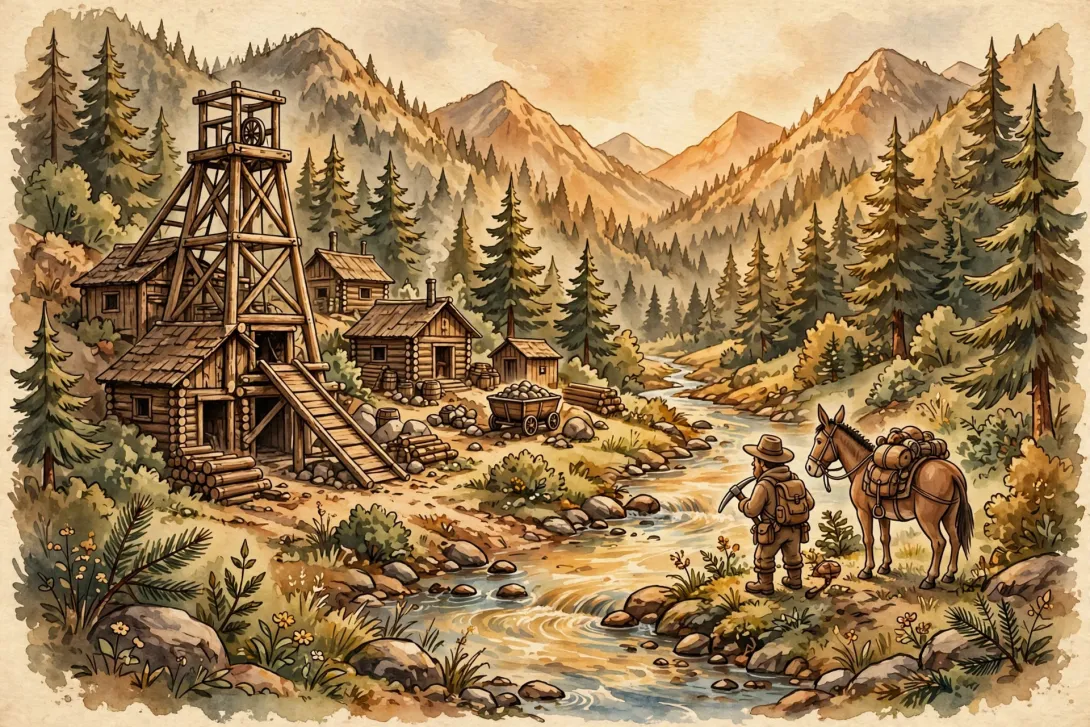
In September 1885, a prospector named Noah Kellogg was combing the hills above Milo Creek in Idaho's northern panhandle when the jackass he had been grubstaked with wandered off. When Kellogg tracked it down, legend says the animal was standing on a glittering outcropping of galena, a lead-silver ore, gazing across the canyon at another. That chance discovery became the Bunker Hill and Sullivan lode, one of the largest of its kind in the world — and the town that grew up nearby took Kellogg's name.
Kellogg's find ignited a rush that was already smoldering. Two years earlier, placer gold on Prichard Creek had drawn thousands; by 1884 the boomtown of Murray held some 10,000 hopeful prospectors. But silver, lead, and zinc were the real prize. The Bunker Hill and Sullivan Mine grew into one of the great mines of the American West, working nearly a century and yielding more than 42 million tons of ore, including some 165 million ounces of silver. Smelters rose in Kellogg, rail lines followed the rivers, and a string of company towns — Kellogg, Wallace, Mullan — took root along what would be called the Silver Valley.
No Silver Valley story looms larger than the Sunshine Mine. Begun in 1884 when the Blake brothers filed the Yankee Lode claim, the Sunshine produced more than 360 million ounces of silver over its lifetime — one of the most prolific silver mines in the world. But on the morning of May 2, 1972, fire broke out in the mine's old workings and swept deadly carbon monoxide through its tunnels. Of the 173 miners underground that day, 91 never came home — the worst mining disaster in Idaho history. The Sunshine Miners Memorial near Kellogg lists every name, and each May 2 the valley gathers there to remember. The tragedy helped spur stronger federal mine-safety protections, and the mine worked on until 2001, when silver prices hovered at or below five dollars an ounce.
Wallace calls itself the "Silver Capital of the World," and the claim holds up. The entire downtown sits on the National Register of Historic Places, its brick buildings the legacy of silver wealth. When Interstate 90 threatened to plow through town in the 1970s, locals fought back — and won, sending the freeway on an elevated bypass over the town instead. Today you can tour real silver mines, visit mining museums, and walk streets where every building tells a story.
The valley's great old mines are history, but mining here is not. The Lucky Friday mine near Mullan has operated since 1942; Hecla's deep underground operation produced a record 5.3 million ounces of silver in 2025 and remains Shoshone County's second-largest private employer. All told, this narrow mountain valley has yielded more than 1.2 billion ounces of silver — one of the richest silver regions on earth. When you stand on Schweitzer's slopes gazing east across the panhandle, you are looking across one of the great mining landscapes of the American West.